
The building in which Iran’s Supreme Leader, Ayatollah Ali Khamenei, was martyred was once a palace belonging to the former Shah of Iran, Mohammad Reza Shah Pahlavi.
Can the private residence of any global leader truly be regarded as secure in the modern ageIn a joint military operation by the United States and Israel, the Beit Rahbari compound in central Tehran was reportedly targeted, resulting in the martyrdom of the Supreme Leader, members of his family, and several senior government officials. The building had long served as both the residence and principal office of Ali Khamenei. Following the Islamic Revolution, it came to be known as Beit Rahbari, or the House of Leadership.
After the attack, countless people searched the internet to locate the precise site where this historic tragedy occurred. Many wished to see the building in which Iran’s Supreme Leader, alongside his companions and family members, spent his final moments before departing from this world.
The structure itself was destroyed in the missile strike. However, images of the site where the building once stood have since emerged through television networks, social media platforms, and satellite reporting. What remains visible today is little more than debris, charred trees, and a flat rectangular scar in the earth marking the place where the structure once stood. These haunting scenes are now circulating widely across international media.
In this column, I have attempted to inform readers about the original historical significance of the building that has now been destroyed, and to share verified information and archival references concerning the structure that once occupied this site.

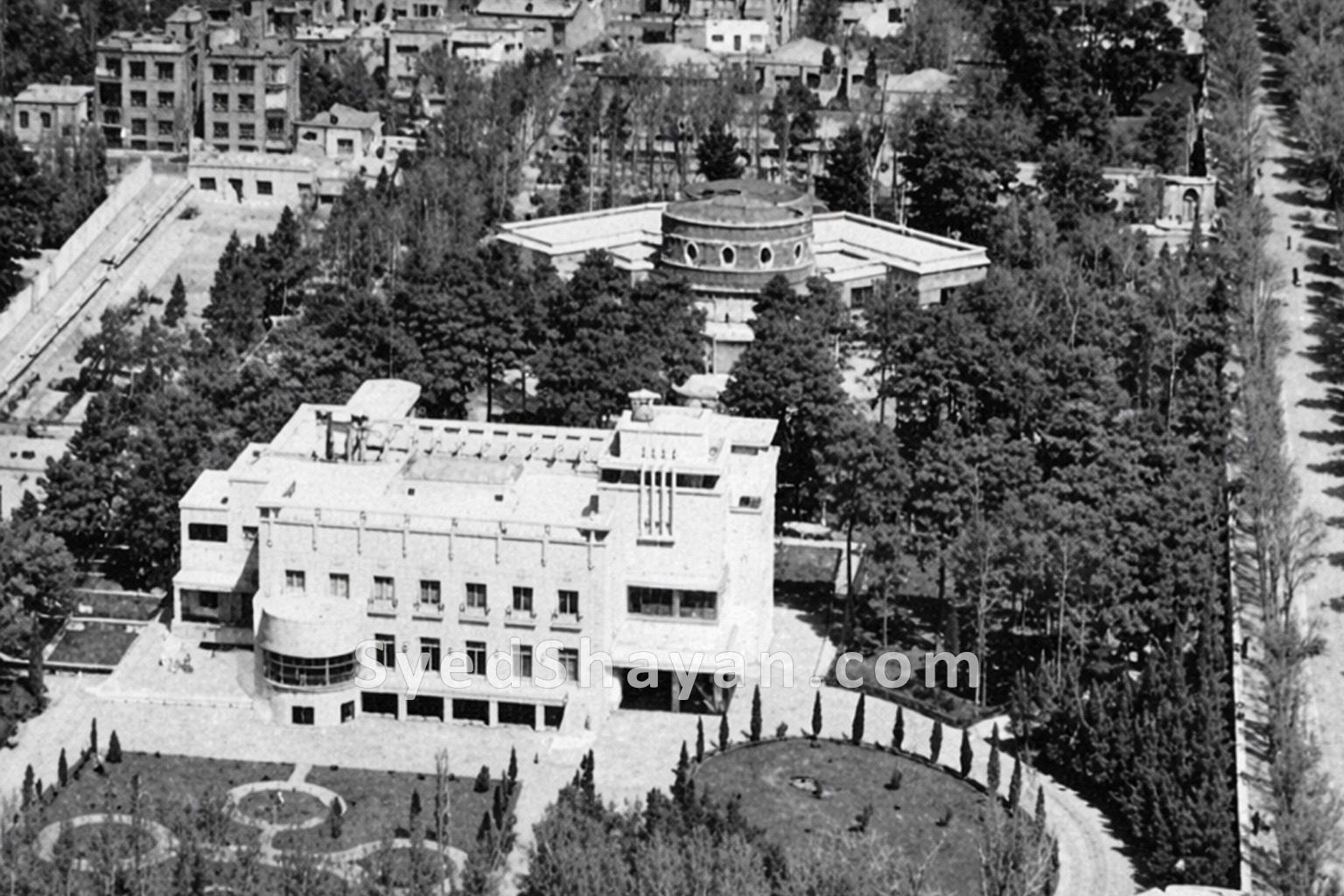
Additional historical photographs of Ekhtesasi Palace and the surrounding area along Pasteur Street have also come to light. These images offer a clearer glimpse into the atmosphere of Tehran during the Pahlavi era and the setting of the royal complex. They are therefore included here as visual references to help place the site within its proper historical cont
▫
Historically speaking, this was a building that witnessed both Imperial Iran and Revolutionary Iran.
During the era of the Iranian monarchy, the building was constructed in 1938 by Reza Shah Pahlavi, the founder of the Pahlavi dynasty, for the residence of his Crown Prince, Mohammad Reza Shah Pahlavi. It was named Ekhtesasi Palace.
The term Ekhtesasi signifies something designated or reserved for a specific individual or purpose. The palace was therefore named Ekhtesasi because it was intended exclusively for the private use of Crown Prince Mohammad Reza Shah.
Unlike the grand royal palaces used for official ceremonies and state affairs, this building was conceived as a private residence for the Crown Prince. At that time, Reza Shah himself resided nearby in the Marble Palace, which functioned as the official residence of the reigning monarch.
For the design and construction of this palace in 1938, Reza Shah commissioned two Hungarian Jewish architects, Laszlo Fischer and Ferenc Bodanzky, who at the time were associated with British Mandate Palestine, a territory that today forms part of modern Israel.
Fischer and Bodanzky had earlier designed the Ministry of Foreign Affairs building in Tehran’s National Garden, a project that impressed Reza Shah. Consequently, he entrusted them with designing a residence for the Crown Prince so that the future monarch’s residence could stand close to the Marble Palace complex where the Shah himself lived.
Mohammad Reza Shah resided in this palace from approximately 1938 until 1941. During this period he had not yet ascended the throne and remained the Crown Prince, while his father Reza Shah lived nearby in the Marble Palace.
Mohammad Reza Shah’s first marriage took place in 1939 with Princess Fawzia of Egypt, in a grand royal ceremony held in Cairo. After the marriage, when Queen Fawzia arrived in Iran, the couple resided for some time in the Ekhtesasi Palace.
In 1941, during the Second World War, Britain and the Soviet Union compelled Reza Shah to abdicate and leave the country. Mohammad Reza Shah subsequently ascended the throne as the Shah of Iran. After becoming king, he moved to the Saadabad Palace Complex, and later established his permanent royal residence at Niavaran Palace.
Following the Islamic Revolution of 1979, Ekhtesasi Palace came under state control. Its status gradually changed from that of a royal residence to a governmental and administrative facility. Over time, the surrounding neighbourhood evolved into a broader governmental complex, and the palace gradually lost its earlier royal identity.
Although the building’s external architectural form remained largely intact, the internal layout was altered. Rooms were converted into offices, meeting rooms, and administrative spaces. Security arrangements around the structure were also strengthened, with additional gates, protective barriers, and surveillance systems introduced.
In the years that followed, particularly between 1981 and 1989 as the Islamic Republic of Iran consolidated its authority, the building was used for high level governmental and diplomatic meetings.
Various foreign delegations and heads of state visited this location over the years. One particularly notable visit was that of Russian President Vladimir Putin.
During his visit to Tehran, when he met Iran’s Supreme Leader Ali Khamenei in this building, he reportedly observed the remarkable simplicity of the meeting room. The room contained plain white walls, modest furniture, an Iranian flag, and a portrait of Ayatollah Khomeini. There were no signs of royal opulence or elaborate decoration.
Iran is famous worldwide for its exquisite carpets, yet instead of expensive Persian carpets, the room was furnished with Zilu, a simple woven cotton floor covering commonly found in mosques, shrines, and modest homes. This striking simplicity reportedly left a strong impression on the visiting Russian leader.
Historical sources also indicate that the building was used by Ayatollah Ali Khamenei during his tenure as President of Iran. The central portion of the structure functioned as the presidential office, where official meetings and administrative affairs were conducted.
In 1989, after Ayatollah Ali Khamenei was selected as the Supreme Leader of Iran, the location was formally transformed into Beit Rahbari, the central office of the Supreme Leader. His offices and residence were established within the same compound, and over time additional structures were constructed around it, turning the area into a large and heavily protected complex.
However, following the reported martyrdom of Iran’s Supreme Leader in the United States and Israeli airstrikes of 28 February 2026, various reports began to emerge regarding the condition of the compound. Early satellite images and unofficial assessments suggested that several structures within the highly secured complex had suffered damage. Because of the strict security surrounding the site, comprehensive details have yet to be fully confirmed.
Nevertheless, the tragedy has raised a profound question across the world.
In the contemporary era, can the private residence of any world leader truly remain secure?
Have the homes of rulers themselves now become targets of war?
Despite its modest appearance, the residence of Iran’s Supreme Leader in Tehran was located within an exceptionally fortified security perimeter. Yet modern military technologies, advanced missile systems, and drone warfare have challenged traditional assumptions about security.
In recent years, a strategy sometimes described as targeted residential strikes has emerged, whereby a political or military leader may be directly targeted at a private residence or personal location.
In earlier times wars were fought along conventional battlefronts. Today, intelligence guided missiles and unmanned aerial systems possess the ability to reach residential compounds with remarkable precision. In response, states have increasingly adopted strategies such as decoy locations and digital shielding, designed to conceal genuine movements and protect actual leadership sites from hostile intelligence.
This raises an important question for the future.
Will leadership residences and official offices in countries such as Pakistan continue to exist as prominent buildings within major cities, or will national leadership increasingly rely on underground bunkers and concealed command centres as the new architecture of political security?
In the emerging landscape of modern warfare, even the homes of the powerful may no longer lie beyond the reach of conflict.
During the era of the Iranian monarchy, the building was constructed in 1938 by Reza Shah Pahlavi, the founder of the Pahlavi dynasty, for the residence of his Crown Prince, Mohammad Reza Shah Pahlavi. It was named Ekhtesasi Palace.
The term Ekhtesasi signifies something designated or reserved for a specific individual or purpose. The palace was therefore named Ekhtesasi because it was intended exclusively for the private use of Crown Prince Mohammad Reza Shah.
Unlike the grand royal palaces used for official ceremonies and state affairs, this building was conceived as a private residence for the Crown Prince. At that time, Reza Shah himself resided nearby in the Marble Palace, which functioned as the official residence of the reigning monarch.
For the design and construction of this palace in 1938, Reza Shah commissioned two Hungarian Jewish architects, Laszlo Fischer and Ferenc Bodanzky, who at the time were associated with British Mandate Palestine, a territory that today forms part of modern Israel.
Fischer and Bodanzky had earlier designed the Ministry of Foreign Affairs building in Tehran’s National Garden, a project that impressed Reza Shah. Consequently, he entrusted them with designing a residence for the Crown Prince so that the future monarch’s residence could stand close to the Marble Palace complex where the Shah himself lived.
Mohammad Reza Shah resided in this palace from approximately 1938 until 1941. During this period he had not yet ascended the throne and remained the Crown Prince, while his father Reza Shah lived nearby in the Marble Palace.
Mohammad Reza Shah’s first marriage took place in 1939 with Princess Fawzia of Egypt, in a grand royal ceremony held in Cairo. After the marriage, when Queen Fawzia arrived in Iran, the couple resided for some time in the Ekhtesasi Palace.
In 1941, during the Second World War, Britain and the Soviet Union compelled Reza Shah to abdicate and leave the country. Mohammad Reza Shah subsequently ascended the throne as the Shah of Iran. After becoming king, he moved to the Saadabad Palace Complex, and later established his permanent royal residence at Niavaran Palace.
Following the Islamic Revolution of 1979, Ekhtesasi Palace came under state control. Its status gradually changed from that of a royal residence to a governmental and administrative facility. Over time, the surrounding neighbourhood evolved into a broader governmental complex, and the palace gradually lost its earlier royal identity.
Although the building’s external architectural form remained largely intact, the internal layout was altered. Rooms were converted into offices, meeting rooms, and administrative spaces. Security arrangements around the structure were also strengthened, with additional gates, protective barriers, and surveillance systems introduced.
In the years that followed, particularly between 1981 and 1989 as the Islamic Republic of Iran consolidated its authority, the building was used for high level governmental and diplomatic meetings.
Various foreign delegations and heads of state visited this location over the years. One particularly notable visit was that of Russian President Vladimir Putin.
During his visit to Tehran, when he met Iran’s Supreme Leader Ali Khamenei in this building, he reportedly observed the remarkable simplicity of the meeting room. The room contained plain white walls, modest furniture, an Iranian flag, and a portrait of Ayatollah Khomeini. There were no signs of royal opulence or elaborate decoration.
Iran is famous worldwide for its exquisite carpets, yet instead of expensive Persian carpets, the room was furnished with Zilu, a simple woven cotton floor covering commonly found in mosques, shrines, and modest homes. This striking simplicity reportedly left a strong impression on the visiting Russian leader.
Historical sources also indicate that the building was used by Ayatollah Ali Khamenei during his tenure as President of Iran. The central portion of the structure functioned as the presidential office, where official meetings and administrative affairs were conducted.
In 1989, after Ayatollah Ali Khamenei was selected as the Supreme Leader of Iran, the location was formally transformed into Beit Rahbari, the central office of the Supreme Leader. His offices and residence were established within the same compound, and over time additional structures were constructed around it, turning the area into a large and heavily protected complex.
However, following the reported martyrdom of Iran’s Supreme Leader in the United States and Israeli airstrikes of 28 February 2026, various reports began to emerge regarding the condition of the compound. Early satellite images and unofficial assessments suggested that several structures within the highly secured complex had suffered damage. Because of the strict security surrounding the site, comprehensive details have yet to be fully confirmed.
Nevertheless, the tragedy has raised a profound question across the world.
In the contemporary era, can the private residence of any world leader truly remain secure?
Have the homes of rulers themselves now become targets of war?
Despite its modest appearance, the residence of Iran’s Supreme Leader in Tehran was located within an exceptionally fortified security perimeter. Yet modern military technologies, advanced missile systems, and drone warfare have challenged traditional assumptions about security.
In recent years, a strategy sometimes described as targeted residential strikes has emerged, whereby a political or military leader may be directly targeted at a private residence or personal location.
In earlier times wars were fought along conventional battlefronts. Today, intelligence guided missiles and unmanned aerial systems possess the ability to reach residential compounds with remarkable precision. In response, states have increasingly adopted strategies such as decoy locations and digital shielding, designed to conceal genuine movements and protect actual leadership sites from hostile intelligence.
This raises an important question for the future.
Will leadership residences and official offices in countries such as Pakistan continue to exist as prominent buildings within major cities, or will national leadership increasingly rely on underground bunkers and concealed command centres as the new architecture of political security?
In the emerging landscape of modern warfare, even the homes of the powerful may no longer lie beyond the reach of conflict.